
Tennessee Financial Literacy Statistics
To clarify where Tennesseeans stand in terms of financial health, the Tennessee Financial Educators Council (TFEC) gathers data and conducts research to accurately inform financial literacy legislation and policy implementation. The Tennessee Council maintains and regularly updates those statistics on this website. We invite policymakers, community leaders, advocates, and researchers dedicated to financial literacy education to employ these data in support of their advocacy and legislative promotion. These statistics serve as one piece of the TFEC’s commitment to the financial wellness movement across Tennessee and nationwide.
Cost of Financial Illiteracy Survey
Tennesseeans report that lack of financial knowledge carries a high cost, according to the NFEC’s most recent survey. Participants across the state responded to the single question: “During the past year, about how much money do you think you lost because you lacked knowledge about personal finances?” The results are shown below. Since 2017, the NFEC has conducted this annual survey, consistently revealing that the average individual cost of financial illiteracy approaches or exceeds $1,000 per person – with estimated national losses reaching into the hundreds of billions of dollars each year, and losses in the hundreds of millions across Tennessee.
Cost of Financial Illiteracy
$0 – $499
$500 – $999
$1,000 – $2,499
$2,500 – $9,999
$10,000 +
Financial Vulnerability in Tennessee
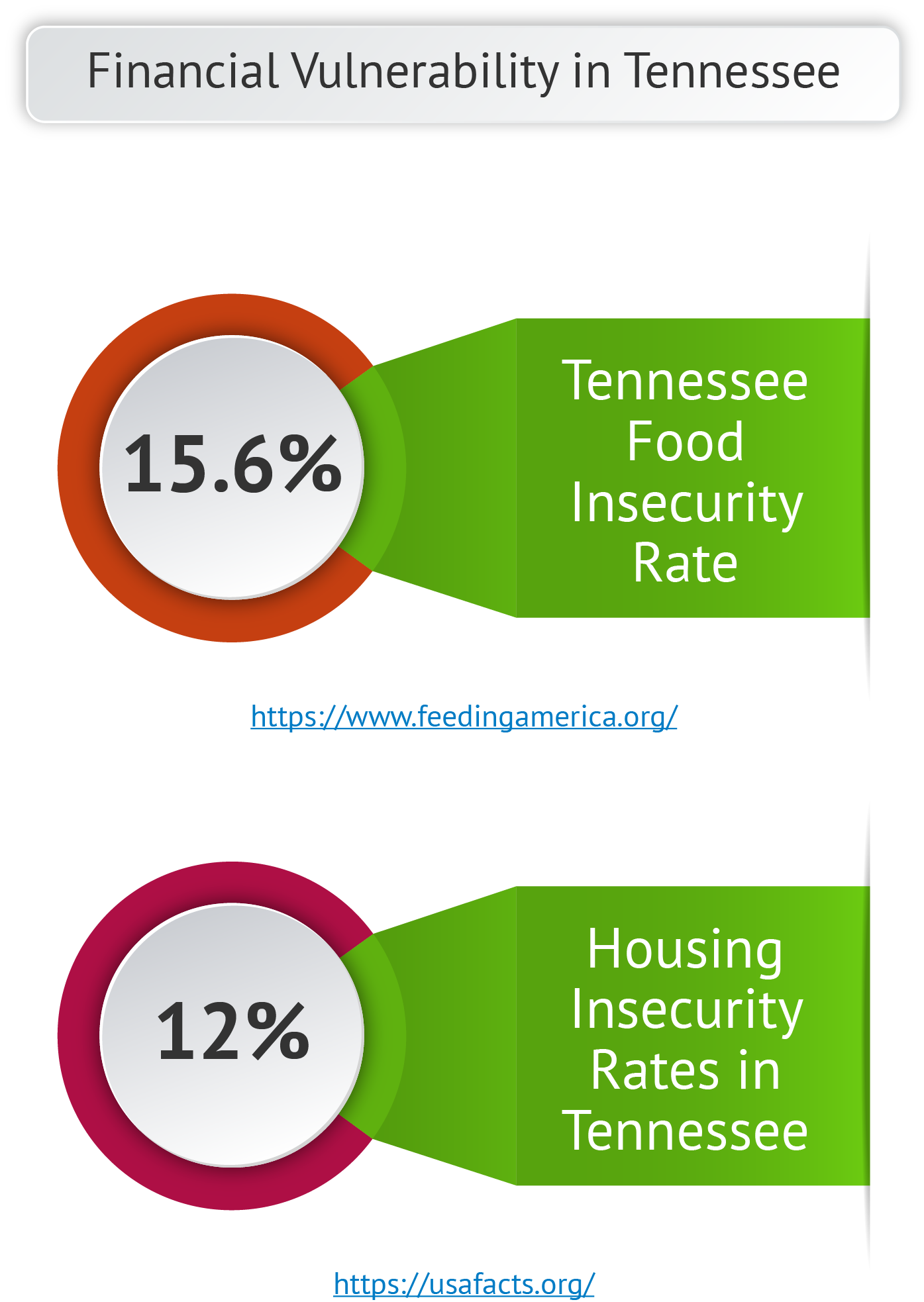
The current financial vulnerabilities being experienced among Tennessee residents can be illustrated through two key measures: food insecurity and housing insecurity. The nonprofit organization Feeding America monitors hunger across the nation and reports the data. Their most recent statistics show that 1,111,150 Tennesseeans face hunger today, including one out of every five children in the state. Charitable programs lack the capacity to completely meet those needs, and must be combined with government benefits like SNAP (formerly food stamps) to fill the meal gap.
A proportion of 12% of Tennessee residents, for a total count of 8,280, were unhoused as of 2024 according to the World Population Review (WPR). The total homeless populations measured consist of two general groups: adults or youths who live by themselves, and those who live in family units. There are more than half a million people experiencing homelessness across the United States.
Specific Data on Financial Situations in Tennessee
Average Total Consumer Debt
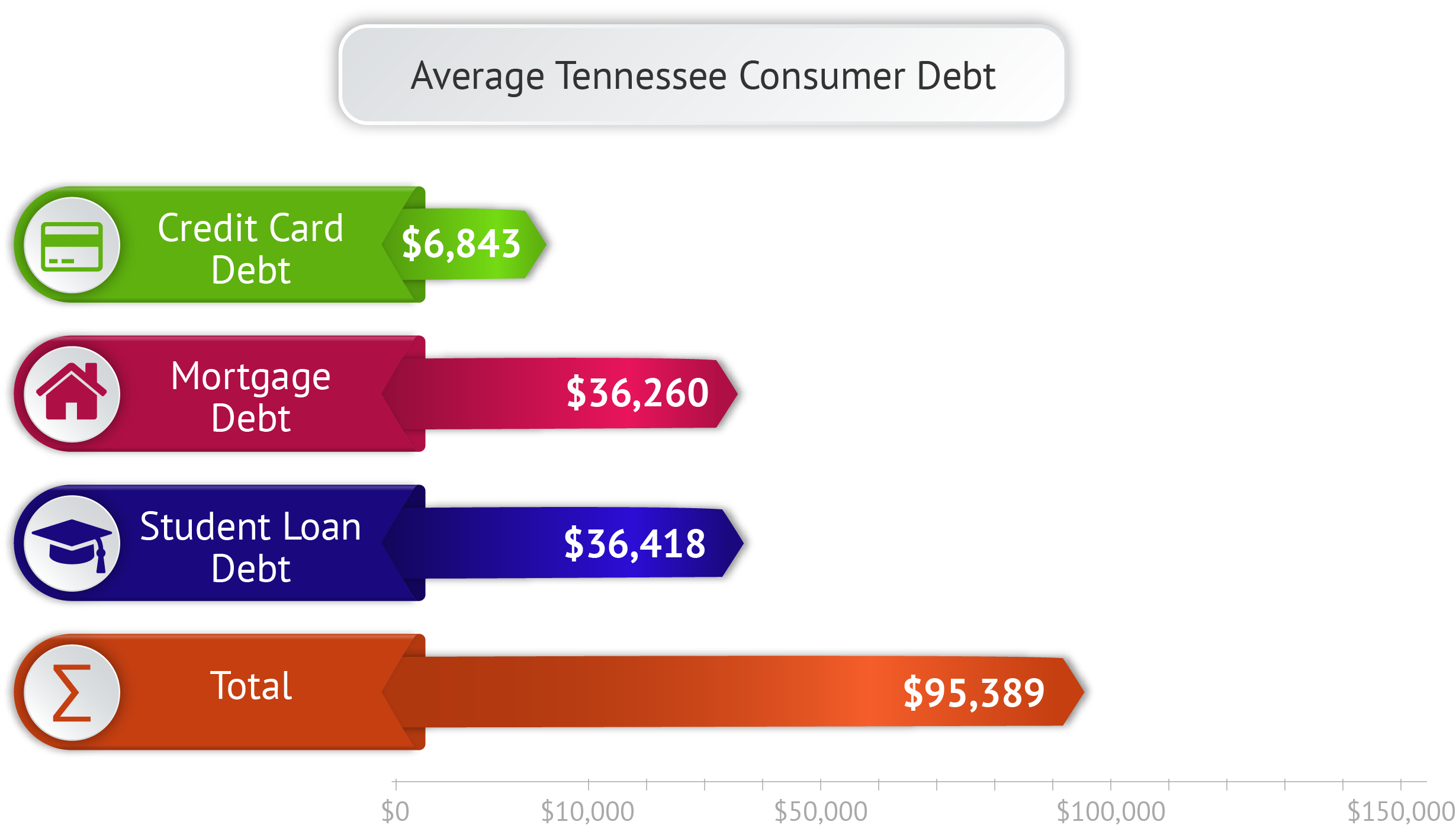
Total consumer debt in the U.S. climbed above $18 trillion by the end of 2025, underscoring the significance of the debt problem among Americans. Tennesseeans face this problem too: in data reported by Experian, their average total debt load was $95,389 in 2025 – which is somewhat lower than the national average (104,755), but still a significant problem; and an increase of 0.4% over 2024 estimates for Tennessee.
Debt by Specific Category in Tennessee
Breaking down the total debt burden into categories, the World Population Review reports that Tennesseeans who carry student loans have an average balance of $36,418. In regard to credit card debt, WalletHub presents 2025 data showing that residents of the Volunteer State owe an average of $6,843 per consumer with a delinquency rate of 9.11%. In 2024 Tennessee had an average mortgage debt rate of $36,260, according to a further WPR report.
Financial Literacy Education and Legislative Statistics for Tennessee
In a report from the National Education Association (NEA), which produces regular information on schools, educators, and student enrollments by state, Tennessee had 146 operating public school districts during the 2023-2024 academic year. Total pupil enrollment in those schools equaled 971,615; and a total of 66,417 teachers were employed to instruct those students. Thus the average public school class size is calculated at 14.6 students per educator.
The primary financial literacy-related legislation currently in place for Tennessee schools is the Tennessee Financial Literacy Act of 2010. The Act’s essential purpose was to create the Financial Literacy Commission (FLC) within the State Department of Treasury. This Commission has a goal “to improve the lives of Tennesseans through financial literacy by providing innovative educational resources to Tennessee schools and families.” Providing resources for students, families, and teachers, the commission has trained 4,850 educators in personal finance education programs to date. They also work with school districts to design and implement custom financial education solutions. The commission’s efforts have produced several financial education programs for K-8 children, including Money Week; the “From Barter to Budget” Traveling Trunk of resource materials; and an age-appropriate, interactive digital learning platform, $martPath. In 2021, the FLC was extended by legislative action through 2027.