Tennessee Financial Literacy Standards
The American Public Education Foundation (APEF) publishes a “report card” every two years that assigns a grade to each U.S. state, DC, and Puerto Rico based on their financial literacy education standards in schools. The latest report – September 2025 – awarded a “B” to the state of Tennessee for its personal finance standards.
The key achievements determining this grade included: requiring a standalone, one-half credit personal finance course as a graduation requirement for high school students; and having financial literacy incorporated into some of the K-8 Social Studies standards. To qualify for an “A,” Tennessee would have to adopt and implement grade-specific financial literacy standards for all grades 3 through 8.
Legislation related to financial literacy in Tennessee is realized largely through the Tennessee Financial Literacy Act, which was signed into law on June 23, 2010. The primary provision of this act was to establish a Financial Literacy Commission (FLC) within the State Department of Treasury with an aim “to improve the lives of Tennesseans through financial literacy by providing innovative educational resources to Tennessee schools and families.” Since inception, the Tennessee FLC claims its major accomplishments as having trained more than 4,850 educators in personal finance education programs; and working with school districts to implement custom financial education solutions. The commission provides resources for students, families, and teachers. In 2021 legislative action extended the FLC through 2027.
TN Financial Education Standards by Grade Level
Personal Finance is an elective course in the Finance career cluster for grades 9-12, and the state provides standards for the course. All high school students must have completed one-half credit of Personal Finance in order to graduate. However, no foundation for taking this course is laid in grades K-8, as financial literacy instruction is not fully embedded in the Tennessee Standards for Social Studies. Grades K-2 do have Economics standards which cover personal finance concepts, but financial education currently is not ensured at all grade levels K-8.
The Tennessee Financial Literacy Commission contributes toward financial literacy education in grades K-8 by providing professional development in personal finance instruction and by sponsoring programs for children including Money Week, the “From Barter to Budget” Traveling Trunk, and the grade-appropriate, interactive digital learning platform $martPath.

Recommended Policy for TN Financial Literacy Programs
To address the gap in standards for personal finance education, the National Financial Educators Council has developed a set of benchmarks for all grade levels, K-12. This policy guide offers legislators a framework that standardizes educational quality and learner outcomes to provide the best possible financial education for American youth.
The Standards Guide is based on the notion that financial education should be treated with the same rigor as any other topic taught in schools and that all students should be capable – at minimum – of making near-term financial decisions.

National Standards for Financial Education
Financial Literacy Standards for Older Youth & Adults (High School through Adults)
Although there is no direct mandate by the Tennessee State Board of Education, it is recommended that national standards be implemented. Financial education is a unique subject; all participants have developed financial habits and relationships with money before instruction begins.
National standards are those that have been proven in empirical and theoretical research to produce the highest improvements in participant test scores.

Financial Literacy Standards for Kids (Kids PK through 8th Grade)
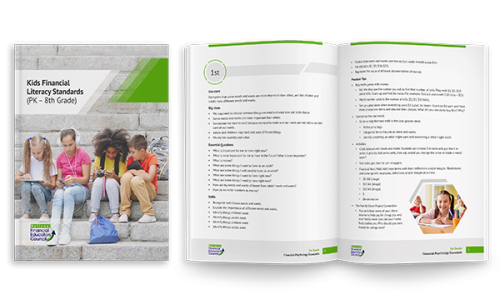
In collaboration with education leader Heidi Jacobs, the NFEC created these financial literacy standards to define learning goals and educational targets for optimal child financial education. Guided by strong pedagogical theory, the standards ensure that instructional targets are age- and developmentally-appropriate and that lessons can be effectively scaffolded. Standards represent five sections based on topic areas in the NFEC curriculum.

Standards for Financial Education Instructors
The NFEC teamed with the well-known Danielson Group to develop the first and only national standards for financial educators – The Framework for Teaching Personal Finance – to define optimal educator skill sets and performance levels. The framework also identifies the financial educator responsibilities empirically proven to produce highest gains in participant test scores. This framework is used in all 50 states, including Tennessee.